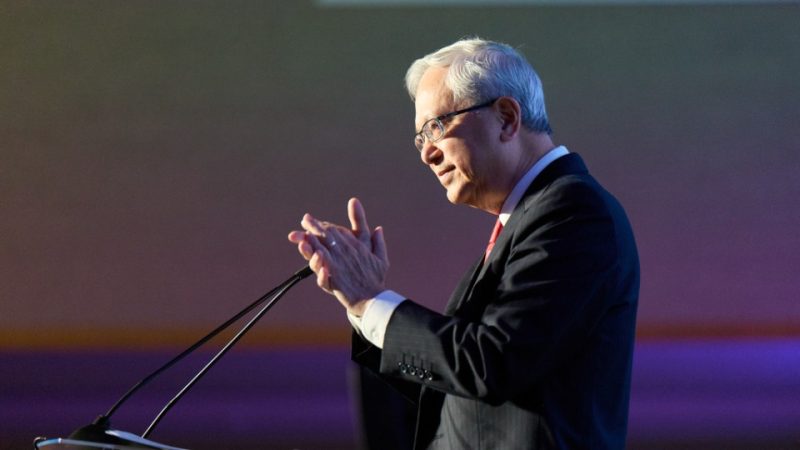
Speaking at the G20 Interfaith Forum in Salt Lake City, Elder Gerrit W. Gong said that faith communities can help ensure artificial intelligence promotes human flourishing and serves the common good. He described faith, moral compass, and human flourishing as essential guideposts in an age of rapidly advancing technology.
“As the ‘internet of things’ becomes the “artificial intelligence of things,” everything connects and communicates—watches, phones, appliances, cars, even smart pet feeders. Each week, my faith community—The Church of Jesus Christ of Latter-day Saints—welcomes 32,000 congregations in 195 countries and territories speaking 125 languages. We use AI for humanitarian and educational services, translation and communication, pastoral and community support, and more. We help individuals and families live and contribute for good in an increasingly complex world.”
In March and April 2024, Elder Gong helped introduce “Principles for Use of Artificial Intelligence,” which includes:
- Spiritual connection means we use AI to support and not supplant connection between God and His children.
- Transparency means our members and congregations understand when they are interfacing with AI.
- Privacy and security mean we use AI to safeguard sacred and personal information.
- Accountability means we ensure accuracy, truthfulness, and compliance in our use of AI.
These guiding principles also apply in our personal lives at home, Church, school, and society.
He said, “We do not fear AI, nor do we think AI answers everything. AI should enhance, not replace, our own human efforts. AI agents, agentic AI orchestration, and changing human-AI interfaces do not change our emphasis on divine principles of faith, work, and inspiration.”
He encouraged establishing benchmark evaluations and a moral and ethical grounding. “The world’s great religious, philosophical, and ethical traditions have guided human civilization and society for millennia. We need that wisdom and those values to anchor AI today. Because many individuals now ask AI about faith, religion, and belief, it is in the common good that AI answer such questions accurately, honestly, and respectfully.”
He concluded with this: “To me, AI will not fulfill its full potential until we make it as morally good as we make it powerful. And we will not fulfill our responsibility until we understand that we, and not any technology, must shape our best future. My great hope is that AI with strong moral compass will contribute to the gift of possibility where anyone everywhere can become their best self and change the world for good.”
- See a news summary of the event.
- Read Elder Gong’s entire remarks.
My experience with this concept differed when applied to local community initiatives. A single failure in implementation can undermine the intended positive outcome.