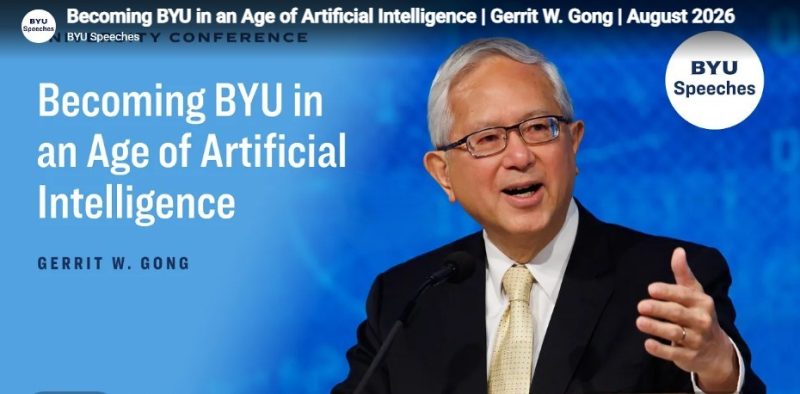
In an address on August 24, 2026, Elder Gerrit W. Gong counseled professors and faculty to take advantage of AI in the student experience at BYU. In his address, “Becoming BYU in an Age of Artificial Intelligence,” Elder Gong presented a balanced and thoughtful approach to artificial intelligence, encouraging BYU faculty and students to neither fear AI nor embrace it uncritically.
Elder Gong said that AI is a powerful tool that will “influence every course, every discipline, every degree, every future family, community and workplace environment for our students, employees, and community.” He said, “We can embrace this opportunity. It gives us an opportunity to reexamine, reimagine and reaffirm our educational principles, purposes, processes, our means and ends.”
The rise of artificial intelligence is among the “greatest opportunities” at BYU and the Church Education System, but it should be used ethically and productively. AI should serve human growth and learning, not replace them.
Elder Gong organized much of his discussion around four major questions regarding AI’s role in BYU education and society.
1. How Should AI Influence Students, Faculty, Staff, and Administrators?
Elder Gong encouraged educators and students to become familiar with AI rather than avoid it. He said it is unrealistic to completely ban AI and expect students to be prepared for a world where the technology is rapidly becoming commonplace. Students need experience using AI tools responsibly because these tools will affect nearly every profession they enter.
At the same time, he warned against using AI as a substitute for personal effort, thinking, or integrity. AI should not promote laziness, dependency, or academic dishonesty. Faculty should develop clear classroom expectations and help students remain accountable for their own work. The goal is for AI to enhance learning and reasoning, not replace the learning process itself. Elder Gong suggested that human character, hard work, judgment, and accountability will remain essential qualities regardless of technological advances.
2. How Should AI Influence Courses, Disciplines, and Degrees?
Elder Gong observed that AI will touch every course, discipline, and degree program. Because of this, universities cannot treat AI as a niche topic relevant only to computer science. Whether students study business, engineering, medicine, education, law, communications, or the humanities, AI is likely to become part of their professional lives.
He encouraged faculty to rethink educational methods and learning experiences. Rather than focusing only on tasks that AI can easily perform, educators should help students develop higher level reasoning, creativity, judgment, problem solving, communication skills, and ethical decision making. AI can help students engage more deeply with real world problems, but educators must ensure that students are still developing their own intellectual capacities. BYU’s challenge is not merely teaching students to use AI, but teaching them how to think well in a world that includes AI.
3. How Should AI Influence Guiding Principles, Values, and Curriculum?
A major portion of Elder Gong’s message focused on principles. He emphasized that AI is fundamentally a collection of mathematical algorithms. It is powerful, but it is not alive, does not possess moral judgment, and should not be viewed as the answer to every problem. Because of this, values and principles become even more important as AI grows more capable.
He suggested that BYU develop AI guidelines rooted in its mission and gospel values. Such principles may align with broader Church guidance while addressing the specific realities of higher education. In practice, this means teaching students to use AI ethically, honestly, and responsibly. The curriculum should help students understand not only what AI can do, but also where its limitations lie and what responsibilities accompany its use.
4. How Can BYU Contribute to Society’s Conversation About Human Identity, Dignity, and Flourishing?
Perhaps the most distinctive part of Elder Gong’s address was his focus on human identity and worth. He argued that BYU has something unique to contribute to the global conversation about AI because it begins with a belief that every person possesses divine worth and eternal potential. Human beings are not merely data points, algorithms, or economic units.
He taught that a BYU education should help students protect and promote moral agency, champion human dignity, and pursue genuine human flourishing. While AI may provide efficiency and productivity, those benefits should be balanced with opportunities for personal growth, individual achievement, and meaningful relationships. The ultimate objective is not simply to create smarter technology but to help people become better individuals, stronger disciples of Christ, and wiser contributors to society.
Key Messages
- Learn AI and use it wisely, rather than fear it or ignore it.
- Use AI to enhance learning, not replace thinking, effort, or integrity.
- Anchor AI use in moral and gospel principles, recognizing both its power and its limitations.
- Keep human dignity, agency, and eternal identity at the center, allowing technology to serve people rather than people serving technology.
In many ways, the talk was less about artificial intelligence and more about what it means to remain fully human in an age of increasingly intelligent machines. Elder Gong’s conclusion was optimistic: AI presents significant opportunities, and BYU can help lead the way by combining technological competence with faith, character, wisdom, and discipleship.
Watch or read his full address at BYU Speeches.
That’s a really interesting perspective. It seems like a careful approach to integrating new technology would be beneficial for BYU’s students.